




By: Ally Azzarelli
Most municipalities know what their communities need; it’s proving it that’s challenging. Aging facilities, uneven programming, and deferred capital requests are symptoms of a common underlying problem: a lack of a documented strategy to translate need into action.
A recreation master plan is the strategic foundation that every parks and recreation department needs to make confident, defensible decisions about infrastructure, programming, and investment. Here’s what the process looks like and whether a community is overdue for one.
What a Recreation Master Plan Is (and Isn’t)
A recreation master plan is a long-range, data-driven strategy that examines a community’s existing parks and facilities, identifies service gaps, and charts a clear path forward, typically across a 10- to 20-year horizon, and accounts for demographics, usage patterns, geographic access, and future growth.
A recreation master plan isn’t a wish list or a budget document and doesn’t just take stock of what exists. It establishes what a community actually needs, what programming those populations will demand, and which capital investments will produce the strongest return for residents and taxpayers.
When facility decisions are made based on whoever spoke loudest at the last council meeting, that’s a gap a master plan is built to close.
The Populations and Use Cases a Good Plan Accounts For
Strong community recreation planning doesn’t only look at who is currently using a facility. It examines who isn’t — and why.
A rigorous parks and recreation strategic plan accounts for youth athletes and their families, older adults who rely on low-impact programming for health and social connection, teens who need supervised spaces after school, adults in competitive leagues, and residents with limited mobility or transportation access. Passive recreation demand matters too: walking trails, park access, and green space are among the top factors residents weigh when deciding where to live and whether to stay.
A plan that overlooks any of those populations has a gap before implementation even begins.
How Master Plans Unlock Recreation Funding
Passing a parks bond or competing for state and federal recreation funding requires more than a strong pitch. Funding bodies and voters need to see that capital requests are grounded in documented community need, not departmental preference.
A master plan provides that documentation, quantifies the deficiency that a bond or grant will address, demonstrates that resident input shaped the priorities, and shows that a long-term strategy exists for what will be built. Communities walking into funding conversations with a completed master plan carry a credibility that those without one simply can’t match.
The Sports Facilities Companies (SFC) has helped communities across the country build the advisory foundation that turns those conversations from hopeful to winnable. For a deeper look at what’s possible when strategy meets infrastructure, read how SFC approaches economic development through sports facilities.
Common Mistakes Communities Make
Reactive capital spending is the most expensive pattern in parks and recreation. A facility is built because a neighboring city built one. A rec center is expanded because a vocal user group pushed for it. Maintenance gets deferred for a decade because no one ever documented what that deferral would cost.
Without a strategic parks and rec plan, departments also struggle to staff correctly, price programming sustainably, or defend their budget during annual appropriations. Although the facility exists, the institutional case for keeping it well-funded does not.
A community center built without a master plan may have been designed for the demographics of 2010, not 2026. Asset-specific planning matters just as much as system-wide strategy; SFC’s piece on why indoor courts and gymnasiums are essential community assets explores exactly that.
What the SFC Master Planning Process Looks Like
SFC’s recreation master planning process starts with a thorough assessment of existing inventory, facilities, programming, financial performance, and physical condition. From there, a community needs analysis is conducted through stakeholder engagement and demographic research to identify gaps between what exists and what the population actually requires.
The plan SFC delivers is a prioritized, phased capital improvement roadmap with clear financial context at every step, a decision-making tool that continues to work long after the engagement ends.
For communities also exploring multi-sport infrastructure as part of a broader recreation strategy, SFC’s work with multi-sport athletic complexes shows what thoughtful, long-range planning can produce.
Start Mapping Your Community’s Future With SFC
A recreation master plan is the most cost-effective tool a parks director or city administrator can have because it prevents the far more expensive mistake of building the wrong thing, at the wrong time, for the wrong population.
For communities that are growing, aging, underserved, or simply facing their next major capital decision without a clear roadmap, the time to build that foundation is before the next budget cycle, not after.
Explore SFC’s Recreation Master Planning services and connect with an advisor today.
Download
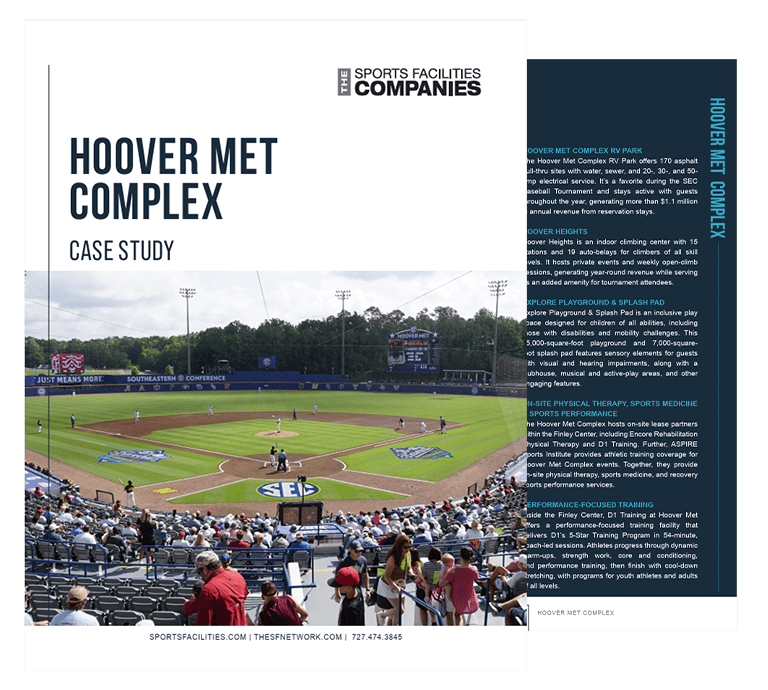
Hoover Met Complex Case Study