




Communities nationwide are discovering that when carefully planned and professionally managed, sports facilities successfully drive tourism, small-business growth, and long-term community investment. Youth sports tourism alone is now a multi-billion-dollar industry, making it a powerful and resilient strategy for economic development.
According to the Sports Tourism: State of the Industry report, $52.2 billion in direct spending comes from youth and amateur sports travel annually, resulting in about $128 billion in total economic impact nationwide and supporting 750,000+ jobs across the U.S.
Whether concepting a new build, remodeling, or enhancing an existing sports complex, the mission remains the same: improve the health and economic vitality of the communities it serves. That means every field, court, ice rink, and aquatics lane must be designed for great experiences as well as measurable impact: room nights, visitor spending, jobs, and new tax revenue.
Why Sports Venues Matter
Sports destinations often have a greater economic impact than expected because they attract visitors from outside the area, such as families who wouldn’t visit without a tournament, showcase, or event. These visitors, no doubt, increase spending at hotels, restaurants, retail shops, and entertainment venues, which in turn generates local tax revenue and reinvestment.
Community sports facilities also support broader economic goals — they enhance quality of life, strengthen a community’s brand, and make cities more attractive to employers, developers, and residents looking for fun, active places to live.
From Games to Growth
As a point of reference, properties managed by The Sports Facilities Companies (SFC) now generate nearly $1 billion in economic impact annually, hosting millions of guests across a national portfolio of tournament-ready venues and community recreation centers.
That impact shows up in:
- Lodging and visitor spend from traveling teams and families
- Job creation in hospitality, retail, and facility operations
- New development from hotels and restaurants to mixed-use districts
- Increased tax revenues that can be reinvested into parks, public safety, and infrastructure
When facilities are part of a professionally managed network, communities also benefit from shared best practices in programming, event booking, food and beverage, and guest experience. That consistency drives repeat business and long-term growth, not just one-off events.
SFC’s SF Network in Action
Across the SF Network, communities are already seeing how sports facilities can reshape their local economy:
- Hoover Met Complex (Hoover, Ala.) – This multi-venue sports destination recently recorded nearly $101 million in economic impact from FY 2024 to FY 2025, highlighting how sustained tournament traffic and strong local programming can transform a regional economy.
- Sand Mountain Park & Amphitheater (Albertville, Ala.) – With over 130 acres of sports, recreation, and entertainment space, Sand Mountain Park produces $14 million in annual economic impact on a $58 million community investment, demonstrating how a single complex can become the centerpiece of both resident life and regional tourism. The facility has also been a magnet for development with new hotels and restaurants sprouting near the complex.
- Rocky Mount Event Center (Rocky Mount, N.C.) – Located in the heart of downtown Rocky Mount, this 165,000-square-foot indoor complex generated more than $25 million in economic impact from FY 2024 to FY 2025 and fueled restaurant and retail growth and activity in the surrounding district.
- Paradise Coast Sports Complex (Naples, Fla.) – Paradise Coast has quickly become one of Florida’s most dynamic examples of how a modern sports destination can anchor tourism, serve residents, and drive long-term economic growth, proving that the right venue can power sports tourism while elevating a region’s brand. And in 2025, PCSC became the home of professional soccer with the launch of FC Naples.
Local leaders see these results firsthand. In Bryan, Texas, where SFC is the operating partner for Legends Event Center, Mayor Bobby Gutierrez summed it up this way: “We’re changing the culture of what people think we can do in Bryan, Texas, with activities, tourism, and an economic focus.”
Getting Started Locally
For communities considering a new sports facility or repositioning an existing one, the way to economic development begins with credible data and a clear definition of goals and success. Independent feasibility studies, financial forecasts, and economic impact reports help leaders understand what to build, how big to build it, and what level of impact is realistically achievable.
From there, thoughtful development and professional management turn plans into performance by aligning design with day-to-day operations, optimizing programming and tournaments, and connecting venues to strong event and tourism networks.
When communities treat sports facilities as strategic economic development assets, they unlock powerful outcomes: more visitors, stronger small businesses, better jobs, and healthier, more vibrant places to live.
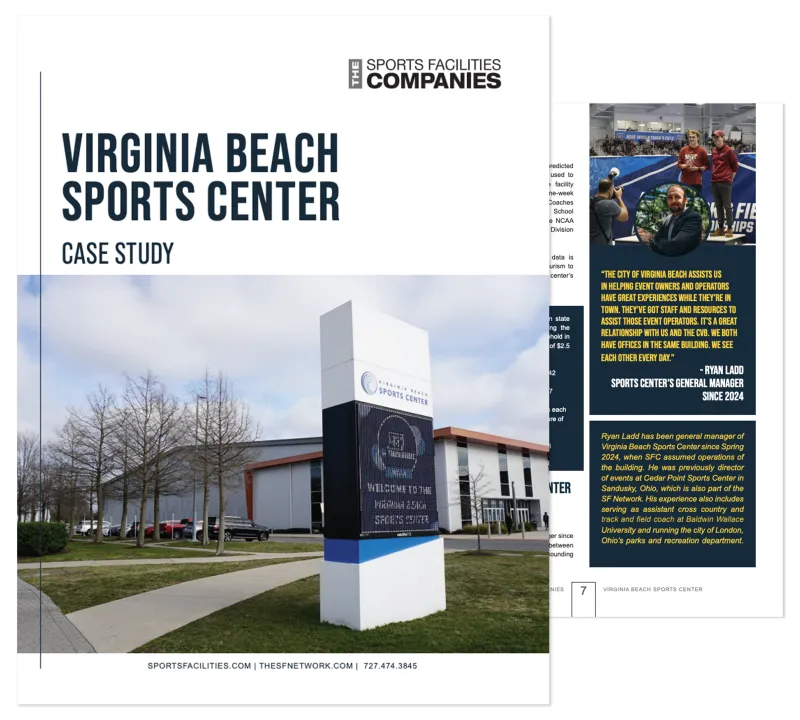
Download
Virginia Beach Sports Center Case Study