




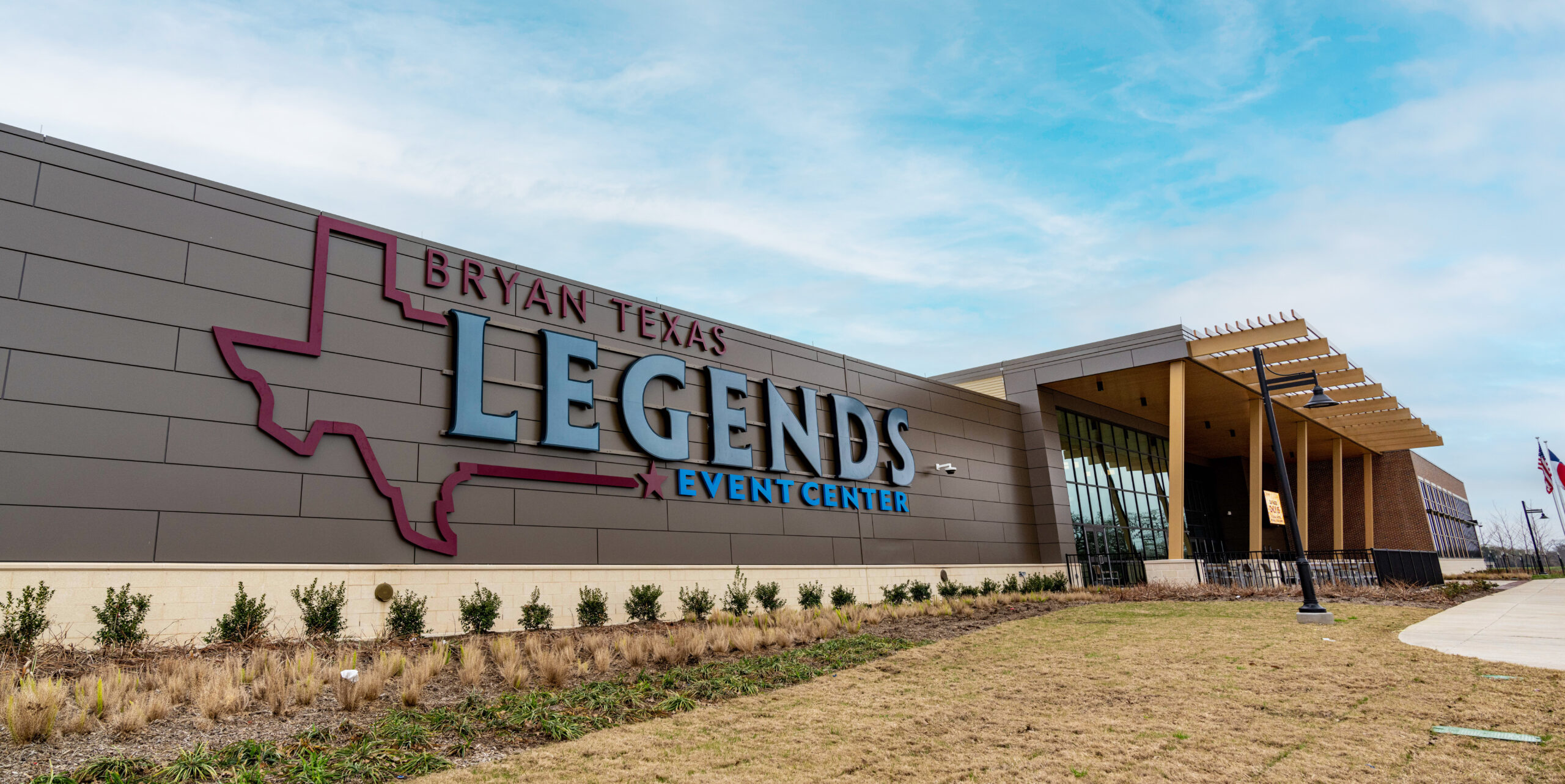
Legends Event Center in Bryan, Texas
By Ally Azzarelli
Not all foot traffic is created equal. A grocery store draws people in, gets them out fast, and sends them home. A sports venue pulls in hundreds of families at a time and then keeps them spending for hours. That’s the core logic behind sports-anchored mixed-use development, and it’s why developers and municipalities are increasingly pairing tournament-ready venues with hotels, restaurants, retail, and public space. The combination doesn’t just create a better guest experience. It creates a fundamentally more valuable, more defensible real estate asset.
Why Foot Traffic Is the Lifeblood of Mixed-Use Real Estate
Mixed-use developments live and die by activation. A restaurant that faces a dead plaza loses while a restaurant that faces a busy sports district wins. The difference is reliable, repeatable traffic, and sports venues deliver it in predictable waves tied to tournament weekends, league nights, and community events. That predictability matters enormously to tenants, lenders, and investors.
According to a Sports Tourism: State of the Industry report, youth and amateur sports travel generate $52.2 billion in direct spending annually, producing approximately $128 billion in total economic impact nationwide. Those visitors, traveling teams, coaches, siblings, and parents, need places to eat, sleep, and spend. The mixed-use district built around a tournament-ready sports venue is positioned to capture that demand directly.
The Power of a Tournament-Ready Sports Anchor
Not every sports venue performs equally as a mixed-use anchor. A rec center designed for residents is not as impactful as a tournament-ready sports complex, built with high court counts, flexible field configurations, adequate parking, and on-site amenities. It attracts out-of-market visitors who travel specifically for events, extending dwell time far beyond what a local-only facility could produce.
Consider in Bryan, Texas. “Every year we are generating more and more economic impact,” Mitchell Isbell, Legends Event Center Director of Business Development and Events, told . “Last year [2025], it was over $30 million. And in our peak summer season last year, between May and August, we generated $15.9 million in economic impact. And that’s directly related to the sports tourism that’s here.”
The facility is integrated into Midtown Park, with lakefront trails, dining options, and nearby commercial activity, turning every tournament weekend into a full-day destination experience. As Bryan Mayor Bobby Gutierrez put it, the facility is “changing the culture of what people think we can do in Bryan, Texas, with activities, tourism, and an economic focus.”
That is precisely what a well-positioned anchor does: it changes the perception of a place and unlocks private investment that wouldn’t have materialized otherwise.
Turning Game Days Into Year-Round District Activation
A well-programmed multi-sport athletic complex can host events 48 to 52 weekends a year, filling the calendar with youth tournaments, adult leagues, corporate events, concerts, and community programming. That year-round cadence is what draws the interest of commercial investors.
The Sports Facilities Companies (SFC) manages venues across a national SFC Network that collectively generates nearly $1 billion in economic impact annually. Properties like Sand Mountain Park & Amphitheater in Albertville, Ala., demonstrate what consistent programming can do: the complex produces $14 million in annual economic impact on a $58 million community investment, while also catalyzing new hotel and restaurant development near the site. Year-round activation isn’t just good for guest experience, it’s good for the entire district ecosystem.
Key Metrics: Visits, Spend, and Long-Term Asset Value
For developers and owners evaluating sports-anchored mixed-use, three metrics matter most: total visits, per-visitor spend, and long-term asset value. A tournament-ready venue reliably drives high visit counts from out-of-market guests who have higher average spend than local day-trippers, they’re booking hotel rooms, eating multiple meals, and visiting local attractions. That spend multiplies through the surrounding district, strengthening the financial case for adjacent tenants and future phases of development.
On the asset value side, properties anchored by a professionally managed sports venue benefit from a stable, traffic-driving use that doesn’t compete with retail neighbors, it feeds them. As economic development through sports facilities continues to prove itself in markets of all sizes, lenders and investors are increasingly treating sports venues as creditworthy anchors rather than speculative uses.
Ready to explore what a sports-anchored mixed-use development could look like for your market? The Sports Facilities Companies has the advisory, development, and management expertise to take your concept from idea to impact. Fill out our contact form or call 727-474-3845 to start the conversation.
Download
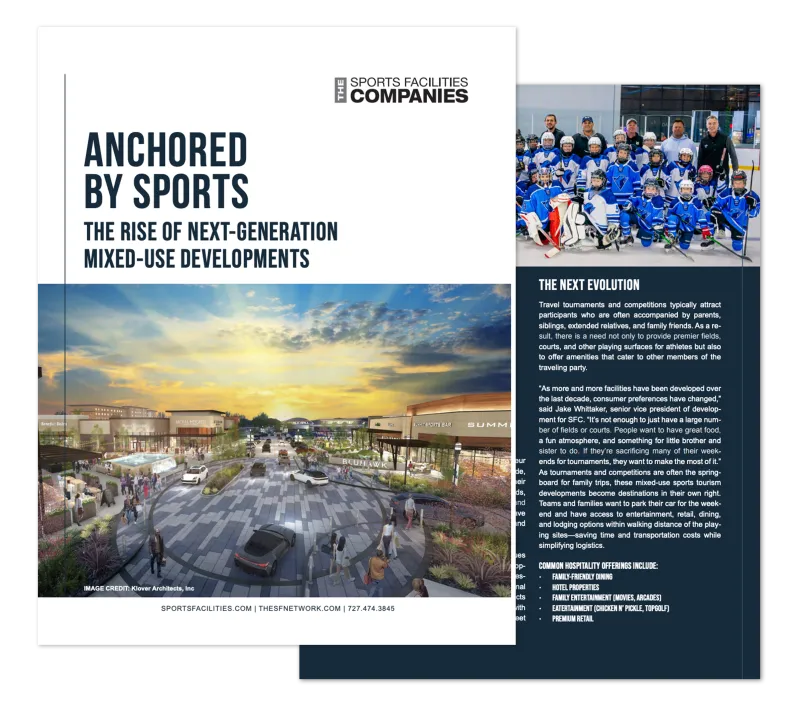
The Rise of Next-Generation Mixed-Use Developments