





Photo Credits: AdobeStock
By Ally Azzarelli
Artificial Intelligence (AI) has become a helpful part of today’s municipal leader’s workday. In a few keystrokes, AI can condense a 200-page consultant report into a council briefing or translate public notices and service announcements into the languages residents speak. In everyday life, AI can do anything from help envision a remodeled kitchen to draft a diet and exercise plan that would otherwise take hours to pull together.
But when a city council is considering a multimillion-dollar sports facility, the feasibility report behind that vote must hold up long after the grand opening.
AI tools can now produce a polished market summary in minutes, and for municipal leaders pressured to move quickly, that speed can feel like the ideal shortcut to getting the answers they need.
The catch is that AI organizes data but doesn’t truly understand your community, potential customers or visitors, or your surrounding market.
At Sports Facilities Companies (SFC), we have spent more than two decades helping 3,500+ communities plan, fund, develop, and manage sports and recreation venues. Our work has produced a proprietary operational dataset built from millions of guest visits and real-world financial outcomes across markets of all sizes throughout the country. That’s work AI simply can’t replicate.
What Is Operational Intelligence?
Operational intelligence is the knowledge that comes from managing real facilities in real communities. It’s the difference between a report assembled from public data and a well-researched plan backed by real-world results from our 140+ managed facilities.
SFC’s operational dataset includes validated financial forecasts, programming benchmarks, staffing models, and market analyses from facilities we have managed. None of it lives in a public database, and no AI model has been trained on it.
AI can generate a financial forecast (pro forma) in seconds, but without real operating data to back it up, the numbers rely on generic assumptions. SFC’s pro formas are built from the performance of facilities we manage, with analysis that goes down to projected usage for each individual asset, whether that’s a court, a field, a pool, or a fitness floor. Every revenue and expense line traces back to how a space is used.
That level of specificity is what separates information from intelligence.
What AI Does Well (and Where It Stops)
AI is an incredibly useful tool, and SFC uses it internally to accelerate research and organize large volumes of information.
The limitation is what AI can’t do. AI cannot:
- Stress-test an operating model against the actual usage, financial results, and economic impact of similar venues
- Translate the P&Ls of operating facilities, and the context behind them, into guidance for your decision
- Accurately benchmark projected operating costs against facilities of similar size, facility type, and environment (physical, political, and economic)
What AI doesn’t have is SFC’s own operating data or the real-world experience to interpret it. That experience, earned by managing similar venues, is what turns data into decisions a municipality can defend.
AI organizes data, but operational intelligence is the backbone that gives data meaning.
Why Municipalities Should Be Cautious With AI-Generated Feasibility Work
Municipal leaders are under constant pressure to make smart investments with public funds. A feasibility study or financial forecast often underpins a multimillion-dollar decision. The stakes are too high for a tool that produces plausible-sounding outputs without the ability to verify them against real operational results.
AI-generated reports can look polished with well-designed charts, projections, and market data. But according to the Stanford HAI 2026 AI Index Report, when 26 leading AI models were tested on difficult factual questions, their hallucination rates ranged from 22% to 94%, meaning AI outputs can sound authoritative while being factually wrong.
Without real operating results to validate those numbers, there’s no way to know whether the projections reflect reality. A feasibility study grounded in generic data is a risk communities can’t afford. SFC’s advisory team produces detailed 5-year cash flow and 20-year financial outlooks covering revenue, expenses, net income, construction costs, start-up costs, and related items.
As Gumaro Martinez, Executive Director of Parks and Leisure Services for the City of Waxahachie, TX, put it: “We definitely feel like the pro forma and feasibility report is going to help impact our community by providing our constituents and our elected officials with the information they need to make an informed evaluation of how to move forward.”
SFC Is AI-Enabled, Not AI-Threatened
SFC isn’t anti-AI. Like 88% of today’s organizations, we actively use AI to accelerate parts of our research and internal workflows. The distinction is that we use AI as a tool within a larger process that’s powered by operational intelligence.
Our 140-facility dataset is the irreplaceable input that makes our advisory work defensible. McKinsey’s 2026 State of AI survey found that only 37% of respondents attribute any measurable bottom-line impact to their AI use. SFC’s advisory clients receive deliverables tied directly to financial outcomes. When our advisors build a pro forma or financial forecast, they draw on results from comparable venues we have operated. When they recommend a programming mix, they reference participation data from communities with similar demographics.
“Anyone can use AI. What they cannot necessarily get from AI is the professional reputation, long-term support, live industry context, and connections to facilities and operators doing this work in real time,” explains Kevin Schuh, SFC Account Executive.
The Real Question for Community Leaders
If you’re a municipal leader evaluating a sports or recreation facility project, AI will likely play a part in your research, and that part will keep growing. The bigger question is who’s providing the intelligence behind the data.
A tool that aggregates and summarizes public information is a useful starting point, but it has a ceiling. AI models predict text that sounds right rather than looking up facts, which means they can occasionally produce numbers that seem credible but aren’t grounded in anything real. So, use AI to get oriented, then verify. When the decision involves your specific community, budget, timeline, or political landscape, the data deserves a source you can stand behind.
Frequently Asked Questions
What is the difference between operational intelligence and artificial intelligence in sports facility planning?
Artificial intelligence organizes and summarizes data from public sources. Operational intelligence uses proprietary, real-world performance data from managed facilities to deliver validated financial forecasts, programming recommendations, and strategic plans tailored to a specific community.
Can AI replace a feasibility study for a sports facility?
No. AI can aggregate market data from public sources, but it cannot validate projections against actual facility outcomes. A credible feasibility study requires operating data from comparable facilities, financial benchmarks, and knowledgeable advisors who understand the complexities of municipal facility development.
What does SFC’s advisory process include?
SFC’s advisory services include market feasibility reports, 5-year cash flow analyses and 20-year financial forecasts, economic impact analyses, competitive analyses, demographic studies, and strategic funding plans. Each deliverable is grounded in data from SFC’s network of managed venues.
Whether you have questions or are ready to dive in, SFC is here to help. Contact us to schedule a discovery call today.
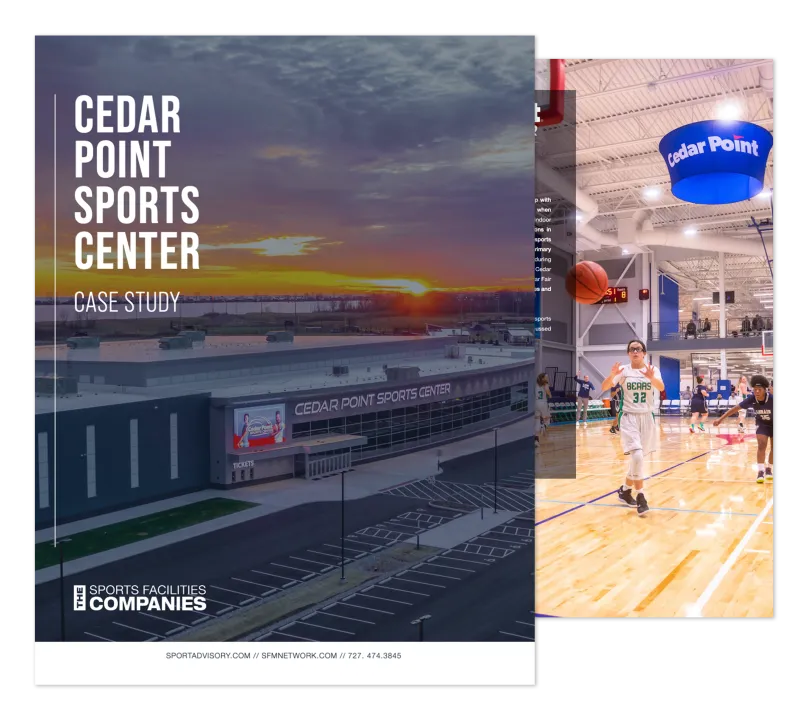
Download
Cedar Point Sports Center Case Study