




By Ally Azzarelli
Most sports facility projects that fail to secure funding do so because the financial model behind the concept can’t withstand scrutiny. A pro forma is where that scrutiny begins, and if it’s built on optimistic assumptions and industry averages, experienced lenders and investors will spot the gaps before you finish your presentation.
What a Pro Forma Is (and Why Lenders Care So Much)
A pro forma is the document that turns a facility concept into a financial argument. It maps anticipated revenues, operating expenses, debt service, and net income across a defined window, five years at the short end, twenty if making a case to a municipal partner or bondholder. What it’s not is a wish list.
Lenders use a pro forma to stress-test assumptions, identify the break-even point, and determine whether the project can service its debt even in a down year. A pro forma that can’t answer those questions becomes more of a liability.
The difference between a pro forma that gets funded and one that collects dust comes down to credibility. Numbers built from real operational data at comparable facilities carry weight. Numbers reverse-engineered from a target revenue goal just don’t, and anyone who has reviewed more than a handful of these documents knows the difference immediately.
Revenue Streams You Should Be Modeling
The mistake most pro formas make is stopping at the obvious revenue lines. A facility with multiple courts or fields generates income through membership and punch-card programs, league registration, clinics and camps, concessions, sponsorships, and ancillary programming like fitness classes or birthday party packages. Model each stream at three levels, conservative, realistic, and optimistic, because a single number tells a stakeholder nothing about the risk they’re actually taking on.
One common mistake is over-indexing on tournament revenue while underestimating the value of day-to-day local programming. Tournaments drive impressive per-event numbers, but they also require significant staffing, setup, and coordination. A facility that builds a reliable membership base generates steadier cash flow and reduces the risk that a few canceled events tank the annual budget.
The Expenses Most Projects Underestimate
Staffing is the most common budget line that projects get wrong, and it’s usually wrong in the same direction. Pre-opening pro formas tend to model a lean team and assume it scales gradually.
What actually happens is that a sports facility needs people before revenue arrives, and the cost of adequate staffing during the ramp-up period is real. Utilities are the second-most underestimated line item, particularly for facilities with aquatics, turf fields requiring climate control, or large footprints with year-round HVAC loads.
Beyond those two, the expenses that most often blindside project teams include:
- Preventive maintenance reserves, which should be funded from day one rather than deferred
- Insurance premiums that increase after the first year of operations
- Technology infrastructure, including point-of-sale systems, registration software, and access control
- Marketing and sales costs required to build awareness in the first 18 to 24 months
- Management fees if the facility operates under a third-party agreement
None of these are surprises to an experienced operator. They’re surprises to a developer who built the pro forma without one.
5-Year vs. 20-Year Financial Outlooks: What’s the Difference?
A five-year pro forma shows lenders whether the project can service its debt and reach operational stability. A twenty-year model shows municipal partners, bond counsel, and long-term investors whether the facility remains viable as a public asset. Both are necessary, and they serve different audiences.
The five-year model needs to be tight and defensible, with clear assumptions behind every revenue projection and expense line, while the twenty-year model requires a different kind of discipline: realistic inflation assumptions and a clear picture of how the facility evolves as the surrounding market changes.
Any facility can look good on paper at year five. The harder question is what year twelve looks like, when the labor costs nobody stress-tested start climbing, when utility expenses that were waived off become line items that hurt, when a slow season exposes just how fragile the programming revenue assumptions always were. A twenty-year forecast doesn’t get easier as the timeline grows. It gets less forgiving.
Red Flags Investors Look for in a Facility Pro Forma
Experienced investors and lenders have reviewed enough of these documents to recognize the patterns that signal a weak model. Revenue projections that show aggressive growth in year one, with no explanation of how that demand was validated.
Expense lines that stay flat across five years despite rising labor and energy costs. A break-even timeline that assumes the facility operates at 80 percent utilization from opening day. Debt service coverage ratios that only work under the optimistic scenario.
Any one of these will prompt questions, and several of them together will end the conversation. A pro forma’s job is to demonstrate that the people behind it understand the business well enough to model it honestly.
Get Institutional-Grade Financial Forecasting
The Sports Facilities Companies builds pro formas from operational data across more than 100 managed facilities, which means the assumptions in your model are anchored to what venues in comparable markets actually earn and spend, not what the industry hopes they might. That distinction is what separates a model that passes due diligence from one that stalls in it.
Every assumption in the model is documented, which matters when a lender’s underwriter starts asking questions you weren’t in the room to answer. Talk to our advisory team to learn more.
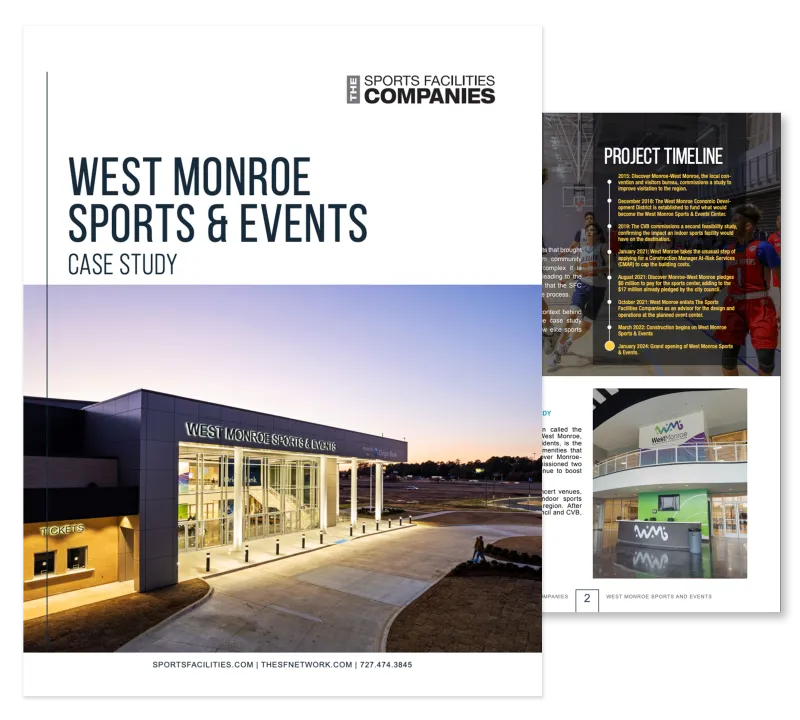
Download
West Monroe Case Study