




By: Ally Azzarelli
If you’re trying to build or fund a sports facility, you’ll eventually face a room full of skeptics, like city council members, who want to know what this will cost taxpayers, CVB directors who need to justify their support, private investors who want to see a return, and lenders who need to know the project pencils out. They need more than words; they need an economic impact report, and if you don’t have one, you’re simply not prepared to handle those questions and concerns.
What Economic Impact Reporting Actually Measures
An economic impact report for a sports facility is a forward-looking forecast that answers one critical question: What does this facility do for the local economy? An economic impact report is neither a construction budget nor a pro forma; it’s the document that quantifies what a proposed venue will generate for the surrounding community across four key areas:
- Direct visitor spending: money spent at hotels, restaurants, gas stations, and retail before and after events
- The multiplier effect: how many times that initial visitor dollar recirculates through the local economy
- Job creation: projected jobs generated across both construction and permanent operations
- Tax revenue: what the facility will generate for the municipality over time
When you add those components together, you get a number that’s hard to argue with in a budget meeting.
Visitor Spending, Room Nights, and Jobs
The most compelling part of any economic impact report is the specificity of the data, because vague projections do not move decision-makers. What moves them is this: a single weekend youth volleyball tournament attracting 40 teams from out of state generates an estimated 600 hotel room nights, $180,000 in direct visitor spending, and $14,000 in local tax revenue. Multiply that by 30 weekends of competitive events per year, and the picture becomes very clear.
A well-constructed sports tourism economic impact report will model these numbers by event type, by season, and by market size, and distinguish between local participation (residents who would spend that money in the community regardless) and out-of-market visitors whose dollars are genuinely new to the local economy. That distinction matters enormously to the people reading the report because out-of-market visitor spending represents true economic development.
Why City Councils and CVBs Want This Data
Local governments and convention and visitors bureaus are under constant pressure to show that public resources are being used wisely. When a city is considering a contribution, a tax increment financing arrangement, or even just a zoning variance for a sports complex, elected officials need something they can hold up to constituents. An economic impact report transforms a sports facility from a line item into an investment thesis.
CVBs core mission is to drive overnight visitation and hotel occupancy, and a sports facility that reliably generates room nights is one of the most predictable tourism infrastructure investments available. The economic impact report allows a CVB director to stand at a board meeting and, with data to back them up, say that this project is worth their organization’s support.
How Economic Impact Reports Strengthen Funding Applications
Whether pursuing a federal grant, a state recreation fund, a private equity partner, or a public-private partnership, every funding application has the same underlying question as to whether it’s worth the money. An economic impact report answers that question in the language funders speak, which is return on investment.
Grant reviewers often score demonstrated economic impact as a formal criterion, and private investors need to see the line between a speculative pitch and a defensible model. Bondholders want to understand how the project supports the tax base that will service the debt. Whatever the funding sources, walking in with this data puts you in a materially stronger position than applicants who are still working from projections on a napkin.
Make the Case With Economic Impact Forecasting
The communities and developers who secure funding, win political support, and build facilities that perform are the ones who show up with the strongest evidence. An economic impact report is how you build that evidence base, and how you walk into stakeholder conversations ready to answer the hardest questions before they’re even asked.
SFC’s advisory team brings operational data from more than 100 managed facilities to every economic impact engagement, which means the numbers in your report are grounded in what comparable venues actually produce, not what the industry hopes they might. The funders and stakeholders you’re trying to convince will have hard questions. SFC can help you show up with answers. Contact us today.
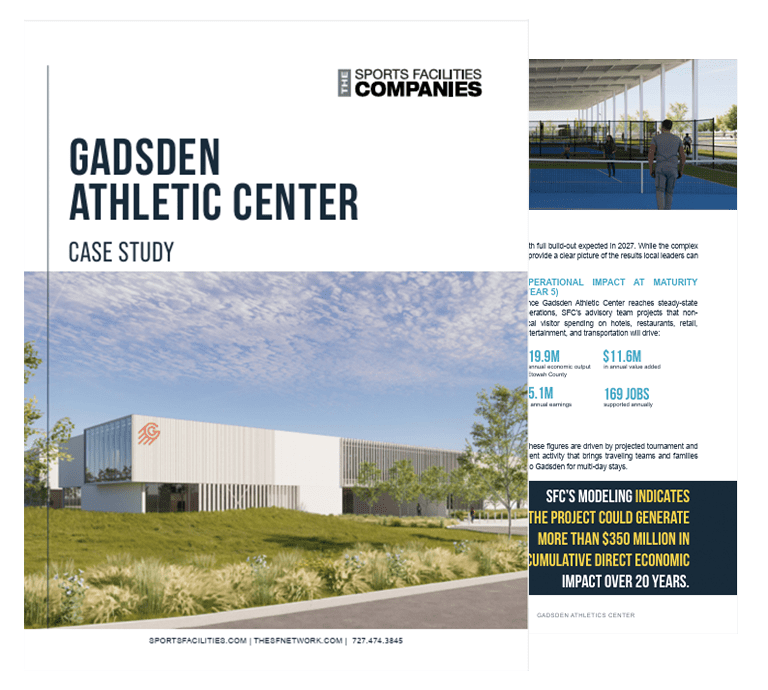
Download
Gadsden athletic center case study