




By: Ally Azzarelli
When a community breaks ground on a youth sports facility, the conversation centers on tournaments, tourism, and tax revenue. Sure, those outcomes matter, but there’s a workforce story inside these venues that deserves significant attention.
The youth sports industry is now a $56 billion global market, and according to the Aspen Institute’s Project Play survey, the average U.S. sports family spent $1,016 per child in 2024, a 46% increase since 2019. Behind every dollar is a network of jobs, and increasingly, those jobs are anchored to purpose-built facilities that function as permanent economic infrastructure.
Construction: More Than a Short-Term Stimulus
Since 2017, more than $9 billion has been invested in youth- and amateur-sport-specific venues nationwide. The Sports Facilities Companies (SFC) alone has 11 facilities opening or breaking ground in 2026, including the $140 million Odessa Sports Complex, designed to be the largest youth sports complex in Texas.
Each project puts local tradespeople to work, such as plumbers, electricians, concrete crews, and the supply chains that support them. But the real planning question for municipalities isn’t whether construction creates jobs. It’s whether the facility generates enough long-term employment after the completion to justify the investment.
Year-Round Operations: The Permanent Employment Engine
Unlike seasonal tourism assets, a well-programmed sports complex operates year-round. SFC employs approximately 5,000 team members across more than 100 managed venues, spanning facility management, event coordination, marketing, food and beverage, maintenance, and guest services. These are full-spectrum employers with career ladders, ranging from event coordinators who book 40–50 tournament weekends annually to marketing professionals who drive national event acquisition.
For communities competing to attract working-age talent, these facilities also serve a dual purpose: they create direct employment and improve quality of life, a factor that consistently ranks among the top decision drivers for young professionals and families choosing where to live. Aaron Smith, Odessa’s City Manager called the new sports complex “a once-in-a-generation investment in our kids and our quality of life,” explicitly linking the facility’s value to talent retention in West Texas.
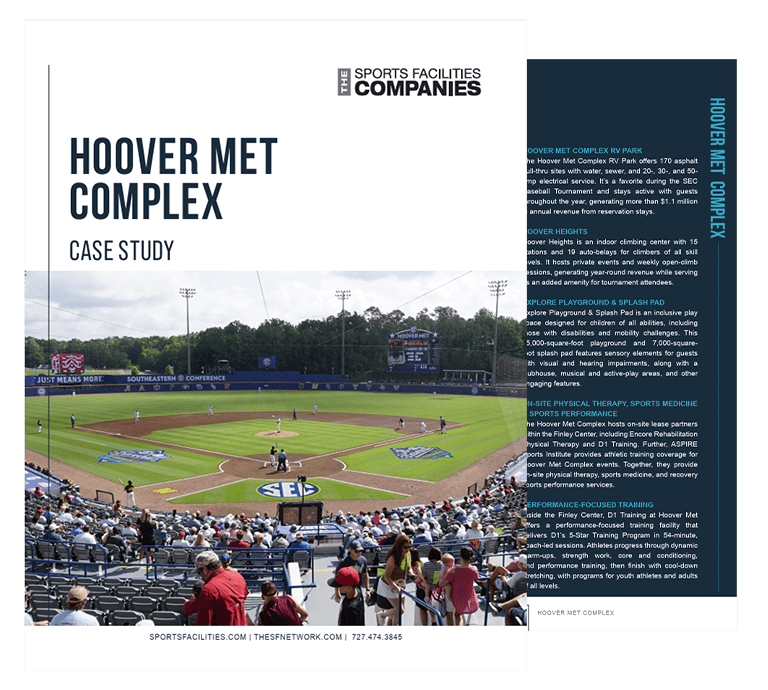
Case Study: Hoover Met Complex, $101 Million in Annual Economic Impact
The SFC-managed Hoover Met Complex in Alabama offers one of the clearest ROI case studies. The city invested $105 million over the past decade to transform a former minor-league stadium into a 150-acre multi-sport campus.
As reported to the Hoover City Council in January 2026, the complex drew a record 785,000 visitors in fiscal 2025, generated $101 million in total economic impact (up 11% year-over-year), and posted $1.3 million in operating profit, continuing a streak of positive margins since 2022.
Business Alabama noted this is unusual because most city-funded sports venues operate at a loss. The complex also generated over 92,000 hotel room nights annually and maintains a 90% repeat rate among event organizers.
Beyond the facility itself, the surrounding area has attracted housing developments, 300 apartment units, the Village Green multi-use arts and entertainment district, and the Stadium Trace Village shopping and dining corridor, private-sector investment catalyzed directly by the facility’s visitor traffic. For municipal decision-makers, the takeaway is specific: a $105 million investment now generates $101 million in annual economic impact, operates at a profit, and has reshaped the surrounding commercial landscape.
The First-Job Pipeline
According to the U.S. Bureau of Labor Statistics, 25% of employed Americans ages 16 to 24 — roughly 5.4 million workers — work in leisure and hospitality, the largest share of any sector for that age group. Sports facilities are a significant part of that ecosystem, offering entry-level roles in customer service, event operations, and recreation programming that build transferable skills.
What makes the sports facility environment distinct from typical first-job settings is the operational complexity. A teenager coordinating field assignments during a multi-day tournament or managing scoreboard operations for a regional basketball showcase is learning project logistics, customer engagement, and problem-solving under pressure, competencies that translate directly into careers in hospitality, event management, and operations.
For communities investing in youth sports infrastructure, this workforce pipeline offers a substantial benefit that goes far beyond the facility’s balance sheet.
The Measurable Multiplier
Youth and amateur sports generated $52.2 billion in travel-related spending nationwide, surpassing spectator sports tourism at $47.1 billion.
Research from the Congressional Research Service has noted that some facility spending reflects displaced local activity rather than net new growth, which is why the tournament model matters: facilities designed to attract out-of-market visitors generate genuinely new spending. A venue programming 40–50 tournament weekends per year pulls outside dollars at a different scale than a community recreation center.
The Bottom Line
Youth sports facilities are workforce infrastructure. During construction, they channel billions into local trades and supply chains. In operation, they sustain year-round teams across management, events, marketing, and maintenance.
Through tourism, they generate $52.2 billion in annual travel spending nationally, outpacing spectator sports. Through first-job pipelines, they develop the next generation of the leisure and hospitality workforce. And through the quality-of-life benefits they deliver, they give communities a competitive edge in attracting and retaining talent.
Every court, field, and complex that opens its doors creates a constellation of jobs, from the ironworker who built the frame to the event coordinator who fills the calendar to the teenager working the concession stand on a Saturday morning. For municipalities and developers evaluating the next generation of community infrastructure, the workforce case is worth close examination.
To learn more about how SFC partners with communities to plan, develop, and manage sports and recreation facilities, contact us online or by phone at 727-474-3845.
Download
Hoover Met Complex Case Study