




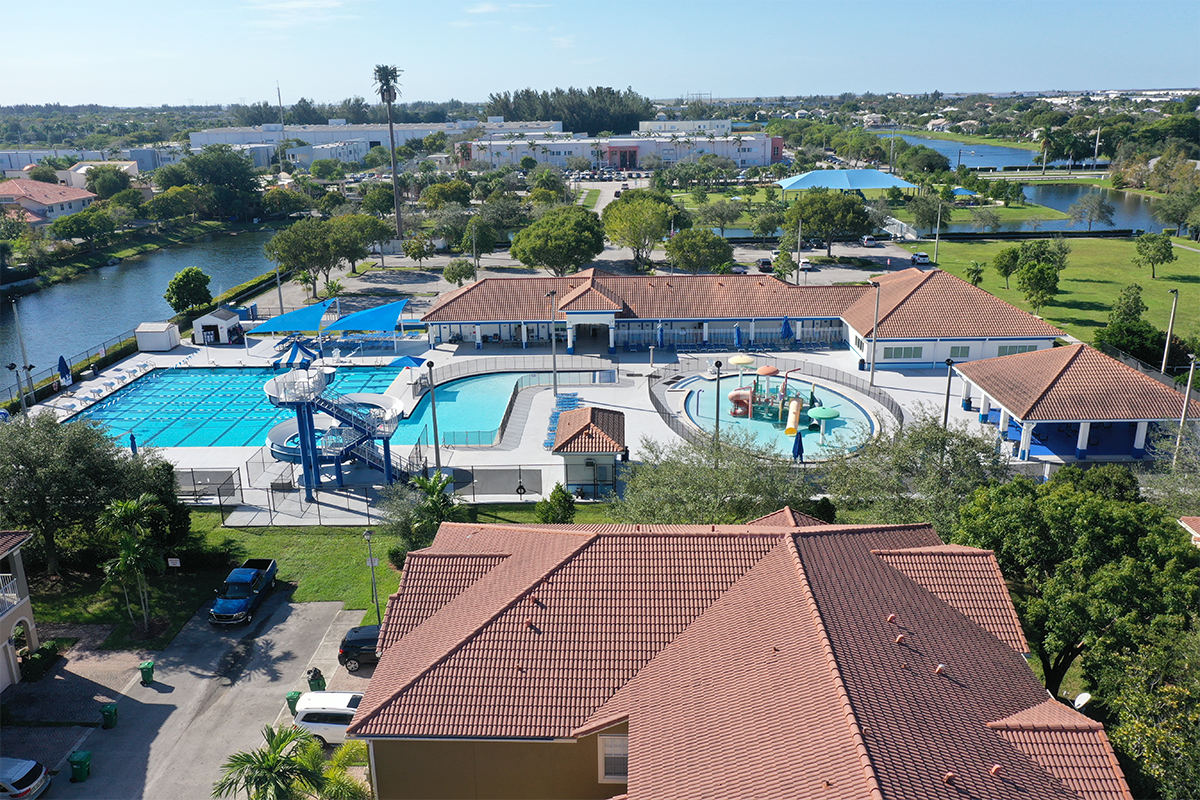
Caporella Aquatics Center in Tamarac, FL
By Johnny Crosskey
Recreational assets like parks and pools have played a major role in community health and quality of life through learn to swim programs, recreational leagues, and free or low-cost access as well as serving as community activity hubs. Traditionally, these assets are considered public amenities and require subsidy to remain affordable and well-maintained. However, shifting political views and proposed property tax cuts, like Florida’s Amendment 3, will significantly alter how Florida cities collect and use property tax revenue if passed.
Report findings from the Tax Foundation, an independent tax policy nonprofit, show that property taxes account for 74 percent of local tax collections in Florida. Reduced property tax revenue creates increased budget pressure for cities. For municipal leaders, hard decisions in terms of annual budgets are looming. Recreational assets, including public pools, could face defunding, layoffs, and even closures. And at that point, the impact goes beyond quality of life and becomes a matter of public safety, especially for residents in low-income brackets who rely on free or low-cost programs.
The Impact of Amendment 3 and Property Tax Adjustment
While public safety is the most critical of the potential impacts of Amendment 3-influenced pool closures, it’s not the only one. Additional impacts may include:
Equitable access for underserved communities: Parks, recreation centers, and public pools offer memberships and programs at deeply discounted rates, or free of charge, in some cases. Defunding recreation can have an outsized effect on marginalized communities that rely on this access. The impact can’t be understated. A study by the CDC, analyzing social vulnerability, found that counties with high social vulnerability, a characteristic driven by lower socioeconomic status, lower education levels, and a higher proportion of mobile homes, experience fatal drowning rates 1.56-1.59 times higher than economically affluent counties.
Community Health and Social Infrastructure: Pools function as civic infrastructure comparable to the role of roads as physical infrastructure, even though they lack statutory protection. According to a study in the Journal of Leisure Research, physical activity at recreation facilities (pools included) can positively influence health, stress, and mood in people ages 50 and older.
When a pool closes, the community loses one of its few intergenerational gathering spaces; a place where seniors swim laps, kids take lessons, and competitive teams train. Urban planners have specifically identified pool and recreation center closures as drivers of “social erosion,” where the absence of free, safe spaces increases isolation among seniors and reduces youth engagement. At a time when former U.S. Surgeon General Dr. Vivek Murthy calls loneliness an “epidemic,” even temporary closures can have significant downstream effects.
Economic & Population Development
Public parks and recreation facilities are economic infrastructure, not simply cost centers. When municipalities close these properties or materially reduce their hours, programming, and maintenance, they do more than eliminate user-fee revenue: they remove amenities that help communities attract and retain residents, businesses, visitors, and private investment. Research from Brookings finds that quality public spaces are associated with stronger surrounding property values, commercial activity, and private-sector development, while the Trust for Public Land identifies parks as tools for attracting residents and businesses and expanding economic vitality. Nationally, local park and recreation agencies’ operations and capital spending generated more than $201 billion in economic activity and supported nearly 1.1 million jobs in 2021, according to the National Recreation and Park Association. A closure may therefore create a longer-term fiscal and economic loss through reduced visitation, weaker nearby property demand, fewer development opportunities, and a less competitive quality-of-life offering—impacts that will not appear in a narrow operating-budget comparison. The precise effect will vary by market and by whether replacement amenities or reinvestment follow, but the broader point is clear: defunding a public asset can diminish the very conditions that support population growth, economic development, and future tax-base expansion.
Keeping Vital Assets Open
Budget cuts are an increasingly frequent reality in the parks and recreation space. Proactive thinking and some new strategies can build a more financially resilient aquatic venue. Consider the following tactics, used by thriving parks and recreation systems throughout the country:
Evaluate your assets: Assess the condition, recurring costs, capacity, and performance of your pools. In terms of performance, it’s critical to understand how many people it serves, memberships, swim lessons, and program and event participation, among other items. Additionally, it’s important to understand where guests are coming from and what other options, both public and private, they have if your pool closes. This data can help you clarify the impact of an open pool versus a closed one and balance that against its costs and the cost of making improvements. This information can help provide budget justification or establish a baseline for pursuing other funding resources.
Innovative revenue generation: While swim lessons, memberships, and facility rentals are all key revenue drivers, more opportunities exist to offset operational costs. Along with popular programming like “Mommy and me” swim lessons and aqua-aerobics, consider programs that target specific interests. Caporella Aquatics Center in Tamarac, FL hosts water fitness classes designed for pregnant and postpartum women. The program focuses on the nuances of this life stage and gives participants to build community.
Depending on the dimensions of your venue, events can be an additional source of revenue and exposure. While there are a number of event types you can host, swimming pools, including Hurst Aquatics in Hurst, Texas, have found success with “swim-in” movies – a liquid take on the traditional drive-in.
Once a year, Pelican Bay Aquatics Center in Edmond, OK hosts Doggie Day. The event allows lovable canines and their humans to enjoy a day at the pool. What’s great about the event is that it invites a population that extends beyond families and aquatics-focused individuals.
Activate Sponsorship and Naming Rights: Value-driven sponsorship programs align corporate investment with tangible community outcomes and strategic brand exposure. By monetizing existing municipal assets, such as facilities, programs, and signage, governments can cultivate tailored public-private partnerships. These strategic alliances secure essential funding to preserve quality-of-life amenities like summer camps and recreation centers. And if you’re questioning the potential value of your aquatics asset for sponsors, consider this: a YouGov study showed that 80% of parents are likely to select the brand that sponsors their child’s youth sports program.
Seek Third-Party Guidance: Recreational assets such as aquatic facilities are noted for their operational complexity. Bringing in a third-party management partner is not an indictment of the abilities of parks and recreation staff, but rather an opportunity to bring in expert knowledge and best practices from similar venues throughout the country.
Third-party management allows a city to retain full ownership and governance control of the venue while bringing in established systems for operations, staffing, maintenance, marketing, sponsorship, and risk mitigation, as well as a back-office structure that supports the on-the-ground team.
Edmond, OK has partnered with the Sports Facilities Companies to manage Pelican Bay since 2016. Through our leadership, the venue’s net operating income increased by 1,150% during that time. Its annual attendance has doubled from 30,000 to over 60,000 guests per season from 2021 to 2025.
Beyond Recreation - Life Saving
At Caporella Aquatics Center, 1,629 people have received swim lessons so far in 2026. That’s 1,629 people who have reduced the risk of succumbing to a drowning accident when entering a pool or body of water. And those swim lessons and learning to swim don’t just impact the individual. It’s a vital skill that those participating children can share with their own kids.
Accidental drowning is the leading cause of death among children ages 1-4. In Florida, the threat is especially significant. A study conducted by personal injury attorneys at Fasig Brooks analyzed Centers for Disease Control and Prevention (CDC) data to calculate the number of drowning deaths in each state over a period of five years. According to their findings, Florida ranks fifth in the country 2.4 deaths by drowning per 100,000 residents. In 2025, Florida recorded its highest number of child drowning deaths at 120, and 74 childhood drownings have occurred so far in 2026.
Whether it’s property tax reform or other factors putting downward pressure on municipal budgets, access to recreational assets, including pools, should be handled with a high level of urgency.
Reviewing the condition, performance, and costs of your aquatics centers is an essential starting point, and one that should be done before budget cuts force action.
For more information on navigating budget cuts due to property tax reform or to learn more about our aquatics optimization study process, call or contact us at 727-474-3845.

Download
How Third-Party Professional Management Delivers Results